
Clinical reasoning is central to medical education, but it can be difficult to observe directly. A learner takes a history, hears new information, adjusts their differential diagnosis and decides what to ask next. In a live consultation, that reasoning process is often hard to pause, revisit and discuss in detail afterwards.
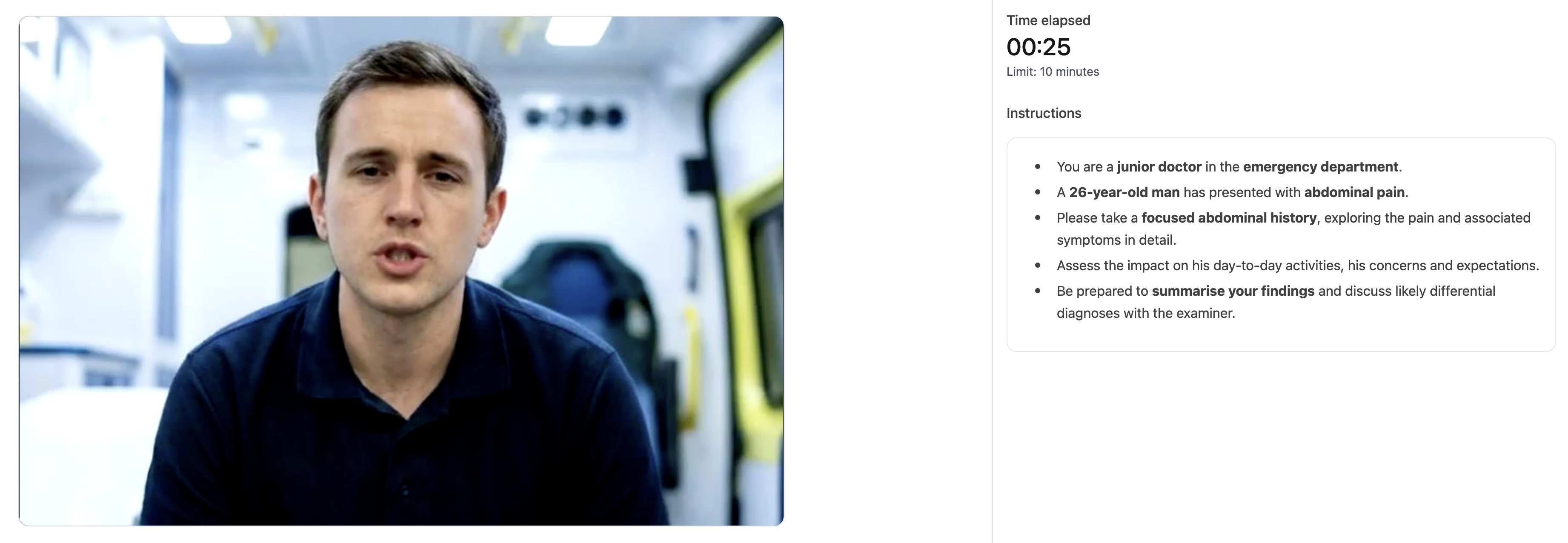
SimChat helps educators create opportunities for learners to practise, review and reflect on clinical reasoning. Learners can take a history from a virtual patient, review the transcript and consider how new information changed their thinking.
Create a free SimChat account to explore how virtual patients could support clinical reasoning teaching.
Using AI simulation to support clinical reasoning
Clinical reasoning involves gathering information, interpreting clinical cues, generating possible explanations and deciding what to do next. In history taking, this means learners need to do more than collect symptoms. They need to understand why each question matters and how each answer affects the clinical picture.
A virtual patient scenario can be designed as a clinical puzzle. The learner starts with an undifferentiated presenting complaint and must decide which areas to explore, which hypotheses to test and when to change direction.
Using the consultation transcript for reflection
Every SimChat consultation creates a transcript of the interaction. This gives learners and educators a shared record of what was actually said, rather than relying on memory or broad impressions after the event.
Learners can use the transcript to reflect on questions such as:
- What was my initial differential diagnosis?
- Why did I ask this question at this point?
- Which answer changed my thinking?
- Did I follow up important cues from the patient?
- Did I ask questions that tested my differential diagnosis?
- Did I consider red flags and serious diagnoses?
- Did I narrow my focus too early?
- What would I ask differently if I repeated the case?
This creates a practical way to move from "I took a history" to "I can explain how I reasoned through the case".
Guided reflection and faculty-led discussion
SimChat scenarios can include faculty-authored questions that prompt learners to reflect on their reasoning after the consultation.
These questions can be tailored to the learning objectives of the case. For example:
- Which diagnoses were you considering after the opening history?
- Which features supported your working diagnosis?
- Which features made alternative diagnoses less likely?
- What would you prioritise in your management plan?
This allows educators to design cases that focus on the reasoning process, rather than only the final diagnosis. A scenario can be used for independent practice, small-group teaching, tutorial discussion or preparation before clinical placement.
Supporting self-review between teaching sessions
Clinical reasoning develops through repeated exposure to cases, feedback and reflection. The challenge is that learners often have limited opportunities to work through clinical scenarios at their own pace and then review their decision-making in detail.
SimChat gives learners a way to practise between taught sessions. They can repeat a case, try a different line of questioning and compare how the consultation unfolds. This can be particularly useful for learners developing confidence in hypothesis-driven history taking.
A learner can complete a case independently, review their transcript and reflect on their approach before discussing the case with a tutor. This can make faculty time more focused, because the discussion can move beyond "what did you ask?" towards "why did you ask it?" and "how did the answer affect your thinking?"
Feedback aligned to faculty-authored criteria
Because SimChat captures the full conversation, feedback can be linked to the learner’s actual questions and responses. Educators can define what good performance looks like using a rubric aligned to the learning objectives of the case.
Feedback can then highlight strengths, missed opportunities and areas for improvement. For example, it might identify that the learner explored the site, severity and timing of pain well, but did not ask about exertional symptoms, associated shortness of breath or relevant cardiovascular risk factors.
Educators can also review transcripts directly and add their own feedback where judgement, nuance or local teaching priorities matter.
Teaching clinical reasoning at scale
In-person teaching remains essential, but it is difficult to give every learner repeated exposure to the same range of clinical presentations. SimChat adds capacity by allowing organisations to create reusable virtual patient cases that can be assigned across cohorts, modules and clinical topics.
Educators can:
- Create virtual patient cases linked to specific clinical reasoning objectives
- Add reflective questions and faculty-authored prompts
- Use transcripts for tutorial discussion, feedback and self-review
- Store cases in a central library aligned to modules or curriculum outcomes
- Control which learners or groups can access each case
- Choose whether learners interact by text, voice or video
SimChat runs in a standard browser, so learners can practise on the device they already use, whether they are on campus, at home or on placement.
Sign up for a free SimChat account and request a demo to see how SimChat can support clinical reasoning teaching across your organisation.